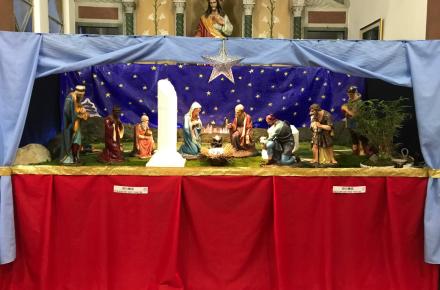
Lent 2026: Jesus' Cross is the victory over our death
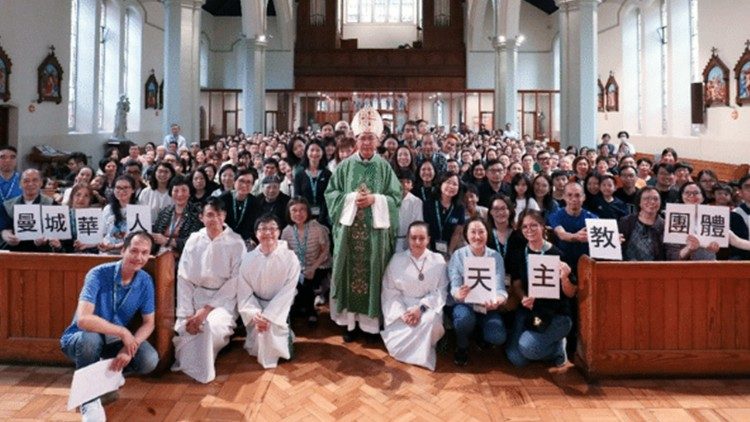
Last March 1st, I preached a Lenten retreat at our parish of St. Theresa in Kowloon. About 200 people attended. March 1st was already the second Sunday of Lent. In setting the retreat date, we had to wait until the major Lunar New Year holidays had passed (as is traditional here in China). The text also includes information (in italics) about the images shown, although my blog doesn't allow more than 10 photos! My deepest apologies. And happy Lent!
2) Cees Nooteboom
On February 11, Cees Nooteboom, a Dutch writer described as "one of the finest interpreters of the 20th century," died in Spain. Nooteboom (July 31, 1933 – February 11, 2026) received numerous awards for his books and was even nominated for the Nobel Prize. One of his books that made him famous—translated into dozens of languages—is "Rituals," written in the 1980s.
3) Cover of “Rituals”
The book's plot revolves around the encounter and clash of three characters.
The first, Arnold Taads, is a former soldier who exposes all the falsehoods and masks behind which men hide, and has come to despise everyone. He lives as if in a fortress, dominated by deadlines and schedules: if someone arrives early for an appointment, he makes them wait until the appointed time. He lives alone with his dog. In the winter, he moves to Canada for months, to a shelter beneath the snow. To stock up on food, once a week he goes down to the village, loads the supplies into a backpack, and then returns to his shelter, walking more than 6 km through deep snow. He knows that if he gets sick on one of these trips, he could die because there is no one to save him. And indeed, one day, that's exactly what happens.
The second character is Arnold's son, Philip Taads, whom his father never wanted to acknowledge. He lives alone, working part-time and devoting his time to Zen Buddhist meditation. He claims to have never found love. He has come to view everything as vanity, especially his own inner emptiness. And so one day, after a Zen ritual of farewell to his acquaintances, he throws himself into the river and dies.
The third character is the protagonist, Inni Wintrop, a man who received a Catholic education as a child but then abandoned it, living day by day. Like a drifter, dragged here and there, he works, but without dedication; he becomes attached to one woman or another and then they break up; he is interested in art, but only for business. He has no memory or regrets: everything in his life is just a fleeting feeling, great and beautiful in the moment, but which is later abandoned and forgotten. He, however, does not commit suicide: he is content to fill his days with disposable thrills, avoiding pain and, above all, staying away from those who suffer.
These three ways of living seem to me to be a snapshot of the way we live in our world.
4) Hong Kong
In Hong Kong, too, there are people dominated by time, trying to conquer a world that they despise, like Arnold Taads.
Here, too, there are people like Philip Taads who contemplate the emptiness of their lives, especially when the role they cherished collapses and fails. Here, too, there are suicides.
And here, too, there are people who are content to live day by day, like Inni Wintrop, fleeing their own pain and that of others, squeezing satisfaction and instinct from things, without memory, without ideals, without expectations.
What is Lent about?
5)Jesus and the Devil
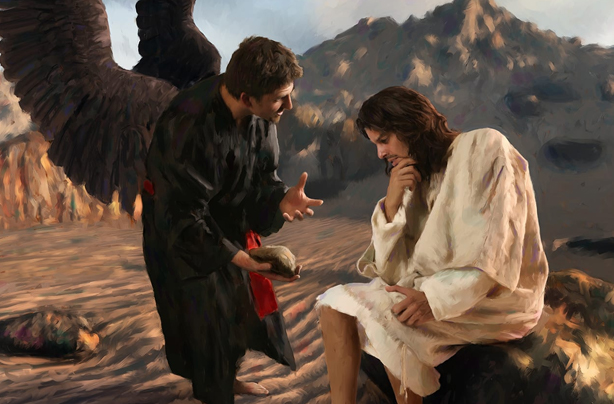
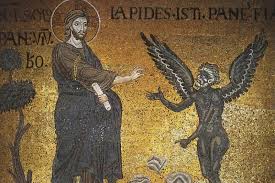
Lent is the season when the Church proclaims that God has come to free us from our meaninglessness, our emptiness, our pettiness. Jesus' battle against Satan in the desert, his victory over temptation, are a sign that Jesus has come to destroy the fortresses of selfishness in which we enclose ourselves; he has come to fill the abyss of emptiness we discover within ourselves; he has come to give us an ideal and a joyful future.
The Gospel tells of a demoniac from Gerasa whom Jesus healed (Mark 5:1-20). The demoniac was violent in all his relationships (he had broken all the chains that tried to restrain him); he would spent time in cemeteries (places of death); he would scream and beat his chest with stones (harming himself). And when Jesus met him, he shouted, "What have you to do with me, Jesus, Son of the Most High God? I adjure you by God, do not torment me!" (Mark 5:7).
6) Jesus wins the Devil
Jesus came to torment and drive out the demons from our lives, those that hold us prisoner: our pride, our emptiness, our superficial living, contenting ourselves with temporary satisfactions.
This is an important first point in our Lenten meditation: Lent is not primarily about what we can do for God (prayers, fasting, almsgiving), but about focusing on what God has done for us!
Indeed, Lent is the time that prepares us to experience and receive the gift of Easter, of Jesus' death for us, and of his victory over death through his resurrection.
From this perspective, the season of Lent is different from Ramadan or Buddhist meditation. In the latter, we fast and pray having our own perfection as our ideal. In Lent, our perfection is the fruit of the perfect gift of the life, death, and resurrection of Jesus, who loved us to the end: it is He who transforms our life and makes it perfect.
Sometimes I feel like we have a "guanxi" relationship with Jesus, one more powerful than us, but on an equal footing, a tool from whom we ask a favor every now and then: help in passing an exam; support in the success of a contract; a medicine that heals us from illness. We forget about Him when we no longer need Him.
In reality, Jesus is not an equal partner, but our Savior; He didn't give us "something," but His entire life. He loved us and bound Himself to us. This is why we love ourselves and all our relationships. He came into the world; He chose us to conquer evil and our death and that of the world. This changes our self-awareness: "It is no longer I who live, but Christ who lives in me; and the life I now live in the flesh I live by faith in the Son of God, who loved me and gave himself for me" (Galatians 2:20).
Our Baptism
7) Praying the Crucifix
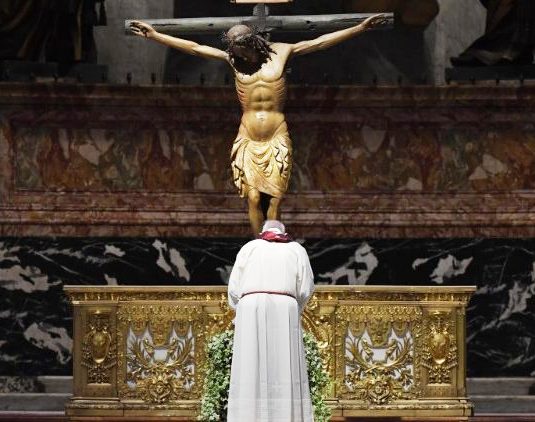
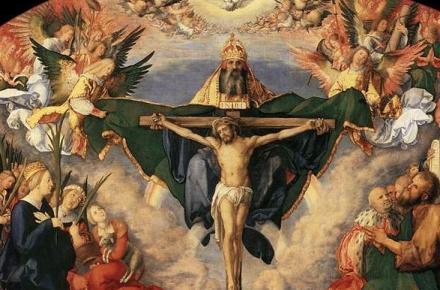
When we participate in the Stations of the Cross during Lent, or meditate on the Passion of Jesus, it's not enough to be moved by a man's tragic fate. We meditate on our liberation, because by dying on the cross, Jesus, the Son of God, took on all the evils, hatreds, and betrayals of the world (and our own) and destroyed them in his death. And with his resurrection, he guaranteed us a present and a future of true and fruitful life, lived together with Him and his power.
Because He has mixed His wounds with ours, we can hope that our wounds will be healed; these wounds are not the final stage of our life, they are glorious, fruitful for us and the world.
His love for us is eternal, forever. We no longer need to lie to get a little attention; we no longer need to accumulate money or power to gain esteem; we no longer need to suppress anyone: Jesus loved us with total love, and this is our dignity, our success, our strength.
8) Baptism on Easter night
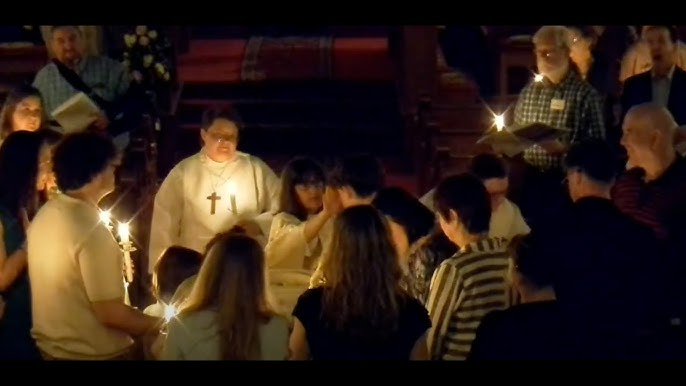
All this happened with our Baptism: "For as many of you as were baptized into Christ have put on Christ. There is neither Jew nor Greek, there is neither slave nor free, there is neither male nor female; for you are all one in Christ Jesus" (Galatians 3:27-28). Cultural (Chinese, Italian, Filipino, Vietnamese, Indonesian, etc.), social (entrepreneur, domestic helper, professor, street cleaner, etc.), and human (male versus female, female versus male) divisions no longer have power because our dignity is Christ Jesus who lives with us.
For this reason, Baptism is conferred on Easter night: because it is the celebration of the victorious love of Jesus Christ over our evils, over our despair and emptiness, over our lack of a future. And for this reason, those who have already received Baptism renew their baptismal promises on Easter night and are blessed with baptismal water.
Before Baptism
What is life before and after Baptism? How should catechumens live as they await Easter night? And we, who have been baptized for a long time, how should we live?
9-Jesus encounters
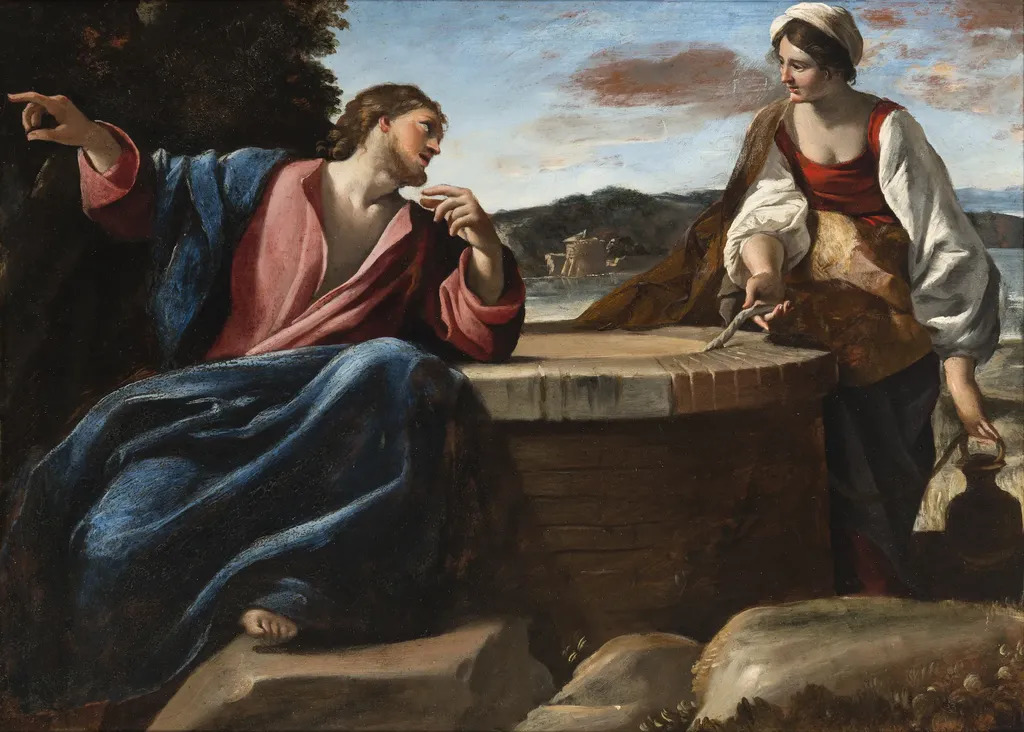
If we look at the liturgy of the Sundays of Lent, we see that on every Sunday the Gospel presents us some persons that through Jesus' encounter are saved: the Samaritan woman, the man born blind, Lazarus who was sick and dead.
The Samaritan woman meets Jesus almost by chance, tired as he stands at the well where she draws water. And this Jew offers her, a Samaritan woman, a special, living water. She discovers that Jesus understands her and loves her a thousand times more than all the six husbands she has had. She abandons her jug of water and runs to announce to her fellow villagers that she has found the Messiah (see John 4).
The man born blind was destined for obscurity and contempt because the Jews thought his blindness was a punishment from God. And yet, upon meeting Jeus, he is healed, and the miracle is so evident that the once-blind testifies to Jesus as a prophet even before the chief priests (see John 9).
Lazarus, the friend whom Jesus loved, falls ill and dies. Jesus arrives, sees everyone weeping, and is moved. Jesus comforts the sisters, who are consoled by the fact that there will be a resurrection at the end of the world. And instead, Jesus says: I am the resurrection and the life now. And at that moment he calls Lazarus, who comes out alive from the tomb. And many believed in Jesus (John 11).
Before Baptism, there is an unexpected, casual encounter with Jesus, a luminous moment in which we discover that our entire life is loved, illuminated, and brought back to life. Every catechumen can tell that, in preparing for baptism, he or she encountered some witness of Jesus who fascinated and understood them. These encounters are the historical signs by which Christ entered our lives and bound himself to us forever. These encounters cannot be forgotten or set aside if we want to live a life in plenitude.
After Baptism. Mission
10) The Church as community
After Baptism, after Easter, the liturgy shows us the life of the first Christian community: persevering in the apostles' teaching, in the breaking of bread, in community life (Acts 2:42-43).
After baptism, the Christian no longer lives alone, but in a community, in relationships established by the risen Jesus and which are the way the Risen One gives us his life: in listening to His Word, offered by the apostles; in the Eucharist; in practicing friendship, brotherhood, and forgiveness among ourselves.
Community is not a series of things to do, but a dimension of our person, a unity stronger than any division, because we were brought together by Jesus Christ.
St. Ignatius of Antioch: "When you gather, the devil and division are defeated" because Jesus is among us.
11) Mission – Mother Teresa
There is one last point I would like to emphasize: Jesus' encounters with the Samaritan woman, the man born blind, Lazarus, and the apostles after the resurrection continue with the mission, with the desire that everyone can know the truth and love of Jesus Christ.
This happens through words and explicit proclamation, but it is prepared first and foremost with listening, patience, solidarity, and love, just as Jesus did with us.
Let us remember one of the characters in "Rituals": I missed love. With our lives full of peace, love, and truth, we offer hope to the world.






 Italian
 English